
How a women-led NGO in North 24 Parganas built a replicable model for sustainable solid waste management initiatives – and where corporate capital can scale them next.
Rooting Sustainability in Public Participation
The Bengal Chamber Foundation (BCF), the CSR wing of the Bengal Chamber of Commerce and Industry, exists to bridge two worlds that rarely meet at scale: corporate sustainability capital and ground-level execution. This blog introduces one of BCF's most compelling grassroots partners — the Clean For Green Foundation.
Registered under the Indian Trusts Act, 1882, Clean For Green Foundation was founded in 2021 by a woman who, after marriage, encountered the reality of rural waste management up close: no systems, no infrastructure, and no plan for the garbage accumulating around her new home. Rather than treat that as someone else's problem to solve, she built an organisation around it.
What began as a personal response to a local gap has grown into a women-led organisation with a genuinely holistic mandate — solid waste management, mangrove afforestation in the Sundarbans, preservation of the Noai River and local water bodies, women's livelihoods, and youth skill-building. Few NGOs operate across that many fronts with equal seriousness, and fewer still can point to a nationally recognised, community-funded project as proof of concept. The Clean For Green Foundation can. The work detailed below shows exactly how and where corporate CSR capital can extend it.
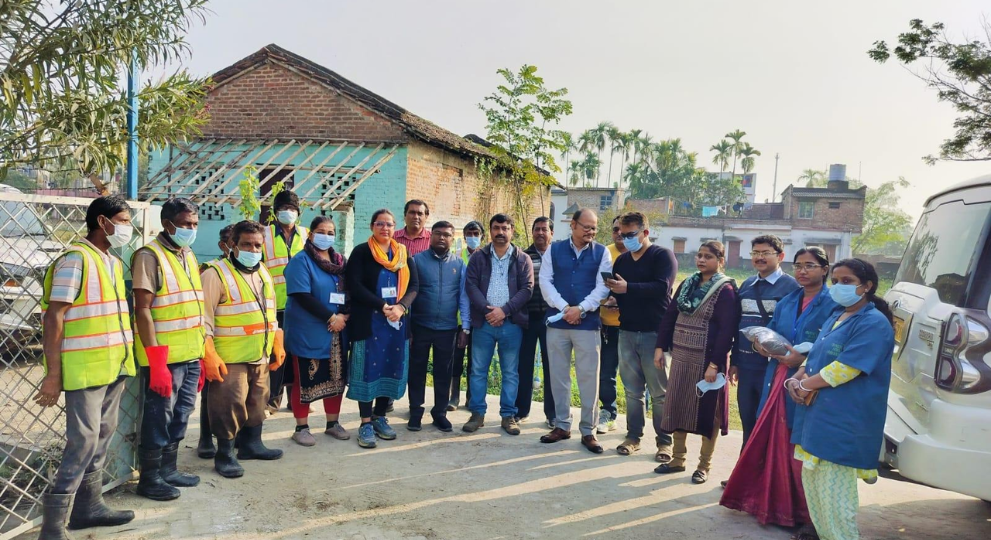
Chapter 1: The Ichhapur-Nilganj Transformation — A Model for Rural SWM
Before Clean For Green Foundation's intervention, the Ichhapur-Nilganj area of Barasat-I Block, North 24 Parganas, faced a problem familiar across rural India: no organised waste system. Garbage piled up along roadsides and in populated areas, turning into breeding grounds for disease and a daily hazard for residents.
The solution wasn't a top-down project — it was a Public-Private Partnership (PPP) between the Ichhapur Nilganj Gram Panchayat and the Clean For Green Foundation, built on the premise that lasting waste management requires community ownership, not just infrastructure.
Execution began with Behaviour Change Communication (BCC) and Information, Education and Communication (IEC) campaigns — door-to-door awareness drives and school programmes designed to shift daily habits, not just install bins. The result was 100% source segregation of household waste into biodegradable and non-biodegradable streams, sustained by a voluntary community user fee that gave residents a direct financial stake in the system's upkeep.
The most distinctive outcome of the project is what happens to the biodegradable share of that waste. The Clean For Green Foundation processes it into "SOIL SATHI" — a nutrient-rich organic fertiliser tested and certified by Bidhan Chandra Krishi Viswavidyalaya, Kalyani. It's a closed loop: household waste segregated by residents becomes farm input for the same region, and the model is one of the clearest examples of sustainable solid waste management initiatives working at the village scale, funded largely by the community itself.
What makes Ichhapur-Nilganj worth studying isn't the novelty of any single component — segregation drives and organic composting aren't new ideas. It's that all of them were sustained simultaneously, with local governance backing and a funding mechanism (the voluntary user fee) that didn't depend on a one-time grant. That combination of behavioural change, institutional partnership, and self-sustaining finance is what typically separates a pilot project from a durable system.
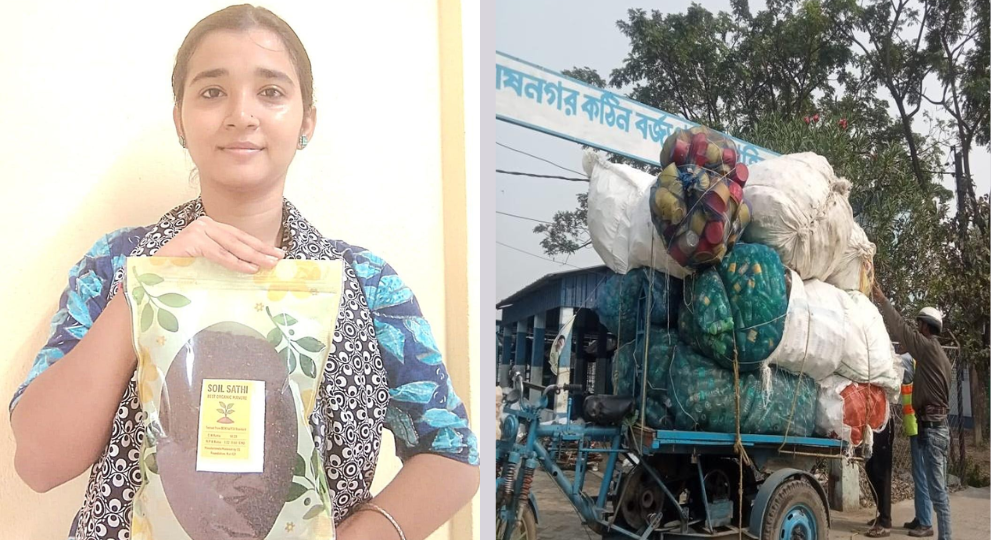
Chapter 2: National Credentials & Reviving "Dead" Infrastructure
The Ichhapur-Nilganj model didn't go unnoticed. The Clean For Green Foundation was awarded the prestigious "Change Makers Award" by the Centre for Science and Environment (CSE), New Delhi, during the Swachh Bharat Mission 2.0 initiative — conferred in the presence of Ms Roopa Mishra (IAS), Joint Secretary and National Mission Director of SBM (MoHUA), and CSE Director General Ms Sunita Narain. That's national-level validation of a grassroots operating model, and it's the kind of institutional credibility corporate CSR teams look for before committing capital.
But recognition also surfaces the scale of the remaining problem. Across West Bengal and across India more broadly, a significant amount of existing waste management infrastructure lies non-functional — not because the systems were poorly designed, but because they lack ongoing management, trained operators, and small-scale machinery to keep them running. Every dead SWM facility is a source point for plastic that eventually reaches rivers and, ultimately, the ocean.
This is precisely the gap CSR support is built to close. Funding machinery, operational training, and capacity building for existing infrastructure is often a far more cost-effective climate intervention than building new systems from scratch – and it's where the Clean For Green Foundation's operational track record makes it a low-risk, high-impact partner.
Chapter 3: High-Impact Environmental Action Windows
The Clean For Green Foundation has identified three specific areas where corporate CSR capital can be deployed for measurable environmental return:
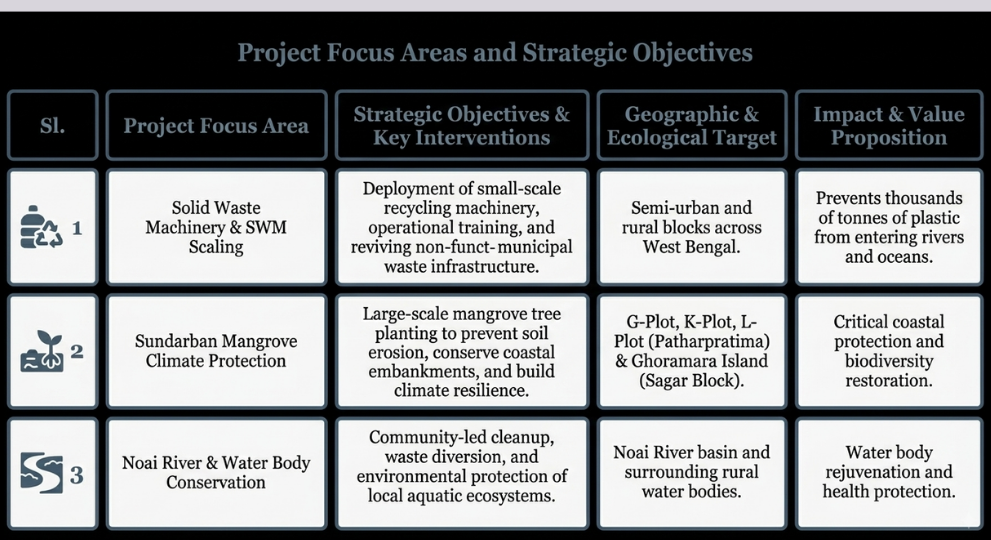
Each of these windows builds directly on capabilities the Clean For Green Foundation has already proven at Ichhapur-Nilganj: community mobilisation, structured waste segregation, and measurable environmental outcomes. What's missing isn't expertise — it's capital to scale sustainable solid waste management initiatives and coastal protection work beyond a single block.
Conclusion
Cleanliness and environmental resilience aren't aspirational goals when the right structure meets sustained community participation — Ichhapur-Nilganj proves that. What the Clean For Green Foundation has built is a replicable, award-validated model ready for expansion into machinery-starved municipalities, eroding Sundarbans coastlines, and threatened river systems.
Reach out to the Bengal Chamber Foundation to partner with the Clean For Green Foundation – or to find the right vetted NGO for your organisation's specific sustainability mandate.