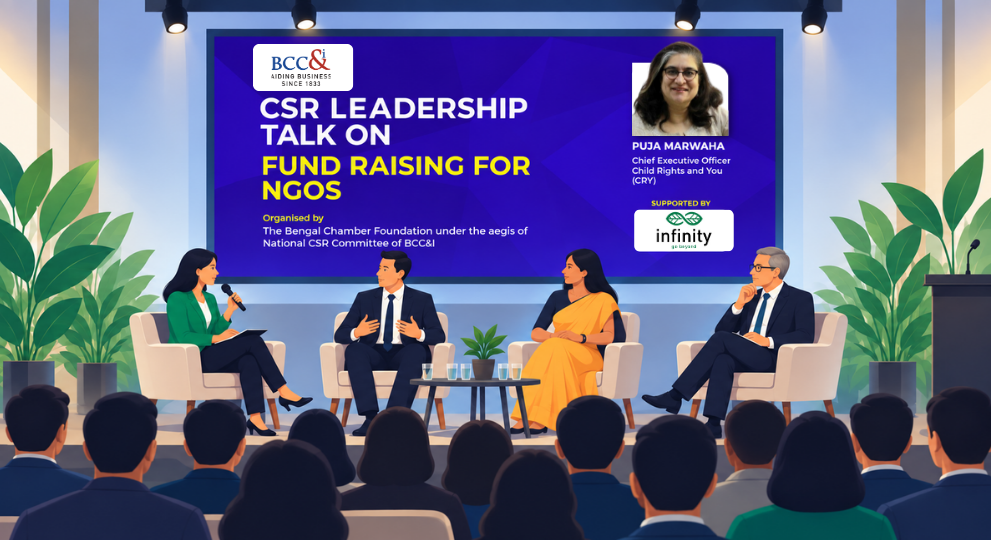
"Money follows confidence, confidence follows credibility, and credibility is built through trust." — Puja Marwaha, Chief Executive Officer, CRY – Child Rights and You
A proposal, however well written, has never been enough to secure lasting funding — that was the message CRY CEO Puja Marwaha brought to a recent Bengal Chamber Foundation CSR Leadership Talk. Sustainable resource mobilisation, she argued, comes from credibility, governance and relationships built over years, not from any single ask.
A Platform Built to Connect CSR Capital With Credible Institutions
The Bengal Chamber Foundation, working under the aegis of the National CSR Committee of The Bengal Chamber of Commerce & Industry (BCC&I), recently brought together NGOs, CSR professionals and development practitioners for a CSR Leadership Talk titled "Beyond the Ask: Building Trust, Partnerships and Sustainable Resource Mobilisation." At the centre of the conversation was Ms Puja Marwaha, CEO of CRY – Child Rights and You, drawing on decades spent building one of India's most recognised child rights organisations.
It is exactly the kind of conversation BCF exists to host. Within Kolkata's CSR ecosystem, the Foundation works as a meeting point — a place where grassroots organisations, corporate CSR leaders and development practitioners can sit across the table from one another, and where credibility, not just compliance, becomes what actually moves the sector forward.
Why Are Donors Rethinking What Fundraising Actually Means?
The idea at the heart of the session was a deceptively simple one: successful fundraising was never really about the ask. It is the outcome of everything an organisation is — its credibility, its sense of purpose, how transparent it is willing to be, and the relationships it has taken the time to build. Ms Marwaha pushed back gently but firmly on the assumption that a persuasive proposal alone can unlock funding.
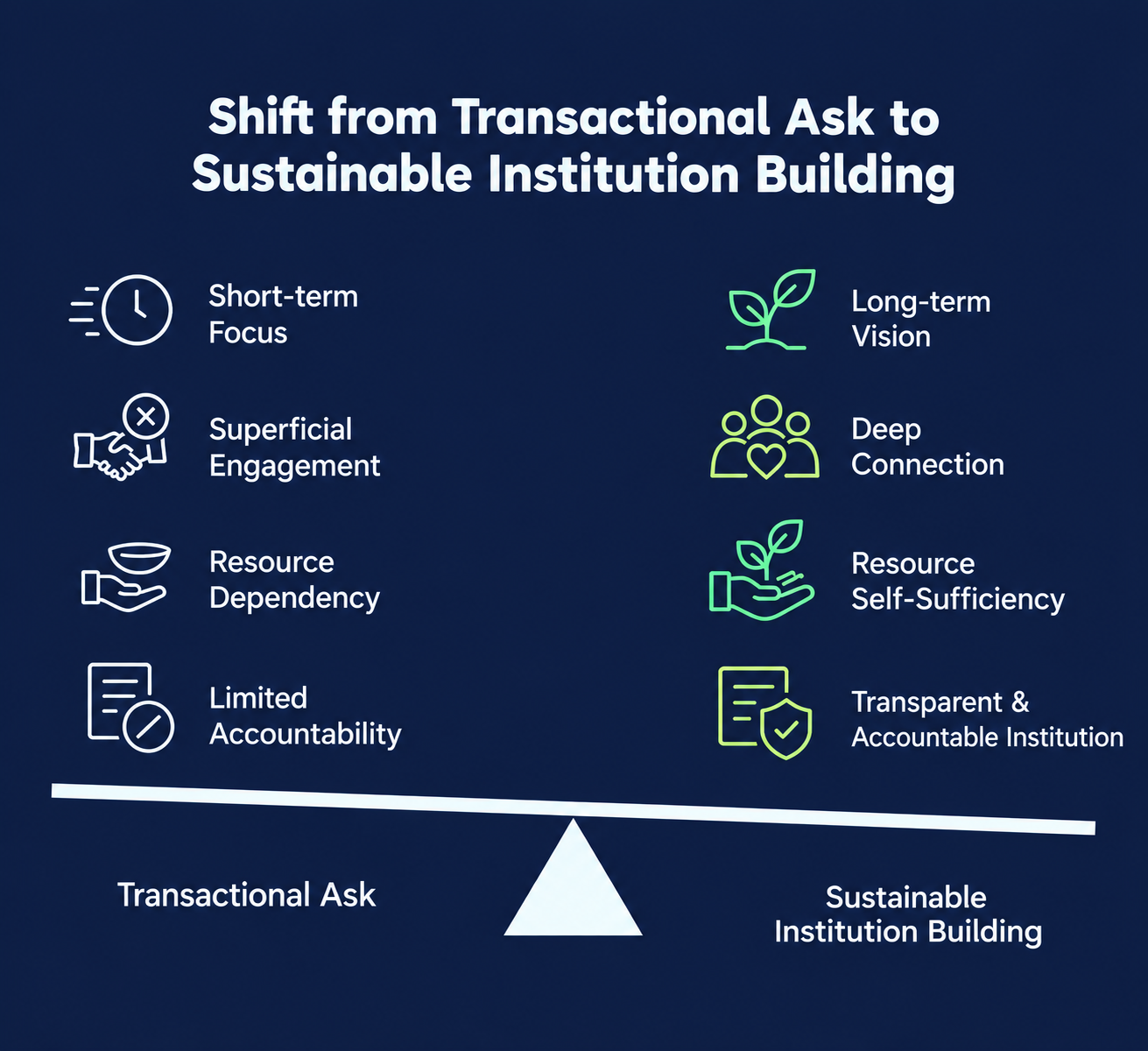
What she described instead was a shift already well under way. Donors and CSR leaders are no longer satisfied by a single project with a neat beginning and end — they want to see institutional capability, sound governance, a willingness to learn, and impact that holds up over time. Fundraising, in other words, is not an event. It is something closer to a habit of institution-building, where trust is either strengthened or quietly chipped away with every report filed, every project delivered, and every conversation had along the way.
The Five Pillars of Sustainable Fundraising
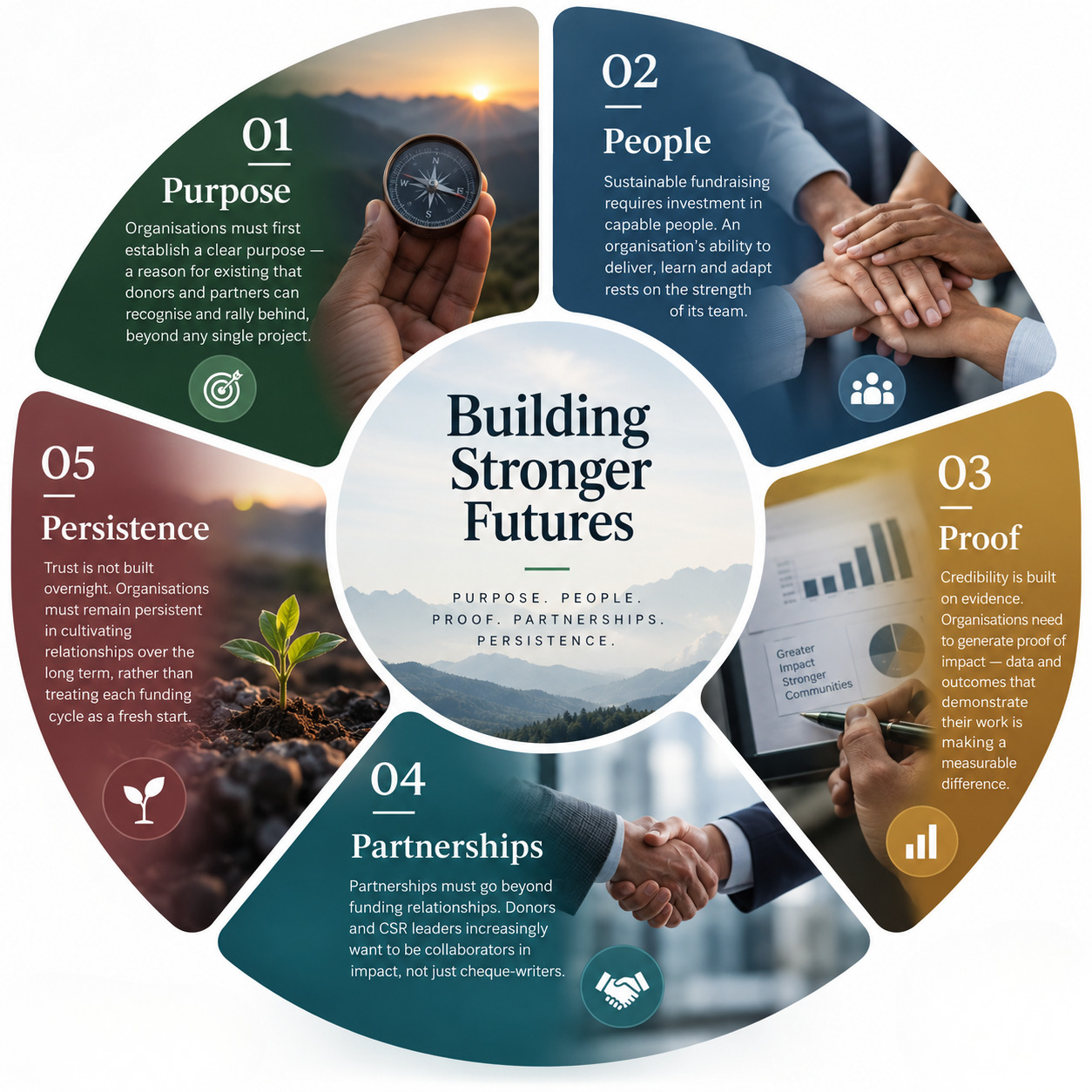
Perhaps the most practical takeaway from the session was a simple framework NGOs can put to immediate use — the Five Pillars of Sustainable Fundraising: Purpose, People, Proof, Partnerships and Persistence.
None of these pillars work especially well on their own. It is only together that they hold up something sturdy enough to withstand donor expectations that keep shifting, year on year.
What Does Accountability Look Like in Today's Development Ecosystem?
One thread ran through much of the discussion: good intentions are no longer enough. What the development ecosystem asks for now is accountability, transparency, a habit of continuous learning, and impact that can actually be measured. Seen this way, fundraising stops being a transaction and starts looking like something closer to relationship-building — the slow work of becoming an organisation that corporates, foundations and philanthropists genuinely trust, not just fund.
For the NGOs BCF works alongside, this distinction is not academic. An organisation that can show its governance, walk a funder through what it has learned, and point to a real track record is one that CSR leaders will back again and again — not just the once.
BCF's Role in Strengthening Kolkata's CSR and Development Ecosystem
Judging by the room, the session struck a nerve. NGOs, CSR professionals and development practitioners engaged deeply, and the conversation spilled well beyond the scheduled discussion — on how to build credibility, how to hold on to partnerships once the initial funding conversation is over, and how to think in decades rather than project cycles.
This is what the CSR Leadership Talk Series is for. Through it, BCC&I keeps offering a space where corporates, civil society organisations and development leaders can exchange ideas, build capacity, and simply talk to one another — work that, session by session, strengthens the wider CSR and social development ecosystem across India.
The session was held under the leadership of Mr Jitendra Kumar, Chairperson of the National CSR Committee, who also serves as President, Legal & Corporate Affairs and Company Secretary. Under his guidance, the Chamber's commitment to responsible business practice has continued to grow, as has the dialogue it enables between corporates and the development sector. The Bengal Chamber Foundation, in no small part because of that leadership, has become a genuine platform for learning, collaboration and collective action.
From Transactions to Trust: The Way Forward
If there is one thing to carry away from this session, it is that sustainable resource mobilisation is rarely won on the strength of one good proposal. It is earned, slowly, through the cumulative work of becoming a credible, transparent and accountable institution. Purpose, people, proof, partnerships and persistence are not lofty ideas to nod along to — they are the practical, unglamorous work that turns a one-time donor into a long-term partner.
For BCF, sessions like this one are a reminder of why this kind of platform matters at all. They give NGOs something to build towards, and they give corporates a reason to trust that what they are funding is built to last.
If your organisation is looking to deploy CSR capital or volunteering support towards credible, governance-driven NGOs, connect with the Bengal Chamber Foundation to explore partnership and engagement opportunities rooted in accountability and long-term impact.
If your organisation is working to strengthen its governance, reporting and impact evidence, consider joining the BCF network to access capacity-building platforms like the CSR Leadership Talk Series and connect with corporates seeking trusted, long-term partners.
Frequently Asked Questions
1. What are the Five Pillars of Sustainable Fundraising introduced at the session?
Purpose, People, Proof, Partnerships and Persistence. Between them, they describe how an NGO builds the kind of institutional credibility that sustainable resource mobilisation actually depends on — rather than leaning on any one project proposal.
2. Why does BCF organise CSR Leadership Talks like this one?
Through the CSR Leadership Talk Series, the Bengal Chamber Foundation keeps a space open for corporates, NGOs and development leaders to learn from one another — conversation by conversation, strengthening the wider CSR and social development ecosystem in India.
3. Why is institutional trust considered more important than a strong funding proposal?
Because donors and CSR leaders are looking past the proposal now, towards evidence of governance, learning and impact that holds up over time. As Ms Marwaha put it, credibility built through trust is what drives confidence — and confidence, in the end, is what leads to funding.
About Bengal Chamber Foundation
The Bengal Chamber Foundation (BCF) is the CSR wing of The Bengal Chamber of Commerce and Industry (BCC&I). Beyond connecting corporates with grassroots organisations, BCF also works as a convening platform for the sector itself, bringing CSR leaders, NGOs and development practitioners together through its ongoing CSR Leadership Talk Series.
These sessions exist to close a different kind of gap — not the one between funding and delivery, but the one between what a single organisation has learned on its own and what the whole sector could learn together. By hosting practitioners from leading development organisations, BCF gives NGOs and CSR professionals a way into frameworks and perspectives that might otherwise stay locked inside one organisation's institutional memory.
Guided by its National CSR Committee, BCF keeps building this shared learning ecosystem, one conversation at a time.
To know more about BCF's initiatives or to partner with the Foundation, visit www.bengalchamberfoundation.org