The mat doesn't care how old you are.
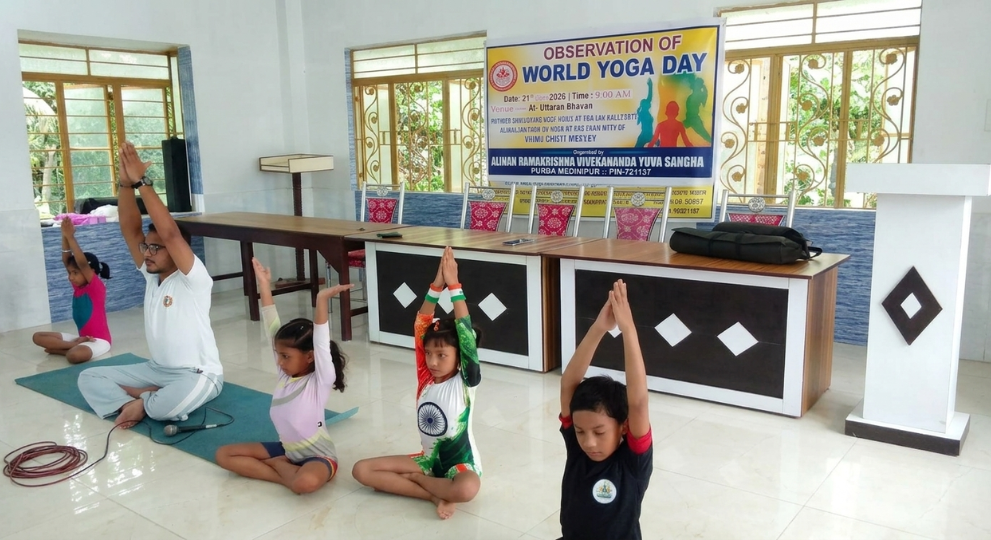
On the morning of June 21, 2026, 85-year-old Kamal Kanta Mandal lowered himself into a seated posture. His traditional Bengali 'dhuti' folded neatly beneath him as he breathed with the steady, quiet rhythm of the teenager training two mats over. Ten years earlier, almost to the day, this same patch of ground in West Bengal held just 11 students and one instructor willing to bet that yoga could become more than a once-a-year observance.
That bet paid off. This is the story of how it happened — and why The Bengal Chamber Foundation (BCF) considers the Yoga Training Centre one of the most credible Verified Community Wellness Projects in West Bengal.
This is precisely where The Bengal Chamber Foundation (BCF) steps in. As the CSR initiative of The Bengal Chamber of Commerce and Industry (BCC&I), BCF identifies, audits, and elevates proven grassroots models like the Yoga Training Centre, a wing of the Alinan Ramakrishna Vivekananda Yuva Sangha—connecting scalable community impact with corporate leaders ready to invest.
Beyond June 21st: How an Annual Observance Became a Way of Life
The Yoga Training Centre began with 11 students on International Yoga Day 2016. Rather than fading after the ceremony ended, it grew into a disciplined, twice-weekly institution — now training 120 regular weekend students under a renowned yoga instructor and standing today as one of BCF's Verified Community Wellness Projects in West Bengal.
Most yoga day events are exactly that — a day. A gathering, a photo, a return to routine by Monday.
The Yoga Training Centre never went back to routine. When the 11 original students rolled up their mats on June 21, 2016, someone made a choice that changed everything: come back next weekend. And the weekend after that.
Nearly a decade of Saturday and Sunday sessions later, that quiet commitment has become a local institution. What started as a single-day observance is now a standing regimen — 120 students strong, guided every week by a renowned yoga instructor who treats the practice not as a hobby but as a discipline worth building a life around.
Growth like that doesn't happen through a single grant or a single campaign. It happens because a community kept showing up, weekend after weekend, for ten years – and it's exactly this kind of sustained, unglamorous consistency that BCF looks for when identifying Verified Community Wellness Projects in West Bengal worth recommending to corporate partners.
Competitive Excellence and Intergenerational Mastery
Building Champions on the Mat
Ask any of the 120 trainees what Saturday mornings look like, and the answer isn't casual stretching. It's structured, competitive, and demanding.
Under their instructor's guidance, students have gone on to win top podium positions at regional and state-level yoga competitions — proof that a rural training ground, run twice a week without fanfare, can produce genuine athletic excellence. For a program built on rural youth sports development in West Bengal, that competitive record is the clearest evidence the training works.
The Morning 148 People Showed Up
If you wanted a single image to capture what this program has become, June 21, 2026, gave you one.
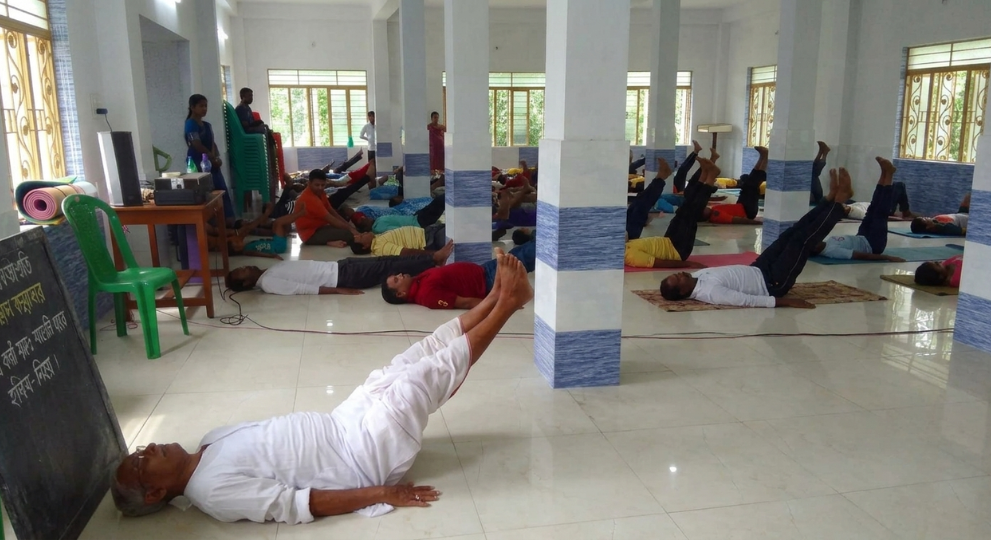
148 participants arrived on the mat that morning — not just students, but teachers, guardians, local citizens, and Management Committee members, all moving through the same sequence of postures together. A yoga class that began as 11 children had grown into something closer to a village-wide ritual.
Agility Without Age: 85 Years of Unbroken Practice
But the detail that stayed with everyone who was there wasn't the headcount. It was the seniors.
Twelve participants between 60 and 85 years old held advanced postures alongside trainees a fraction of their age – no modifications, no hesitation, just years of practice showing in every movement.
And at the centre of it, in every sense, was Mr Kamal Kanta Mandal. At 85 years old, dressed in a traditional 'dhuti', he sat in a posture that many people half his age would find difficult, calm and unhurried, as though he'd done it a thousand times before. He probably had.
Moments like this are why BCF classifies this programme under intergenerational wellness CSR initiatives rather than simply a youth sports project. The story isn't just about young athletes. It's about a rural community where age was never a barrier to discipline.
Compliance, CSR Schedule VII Alignment & Transparency
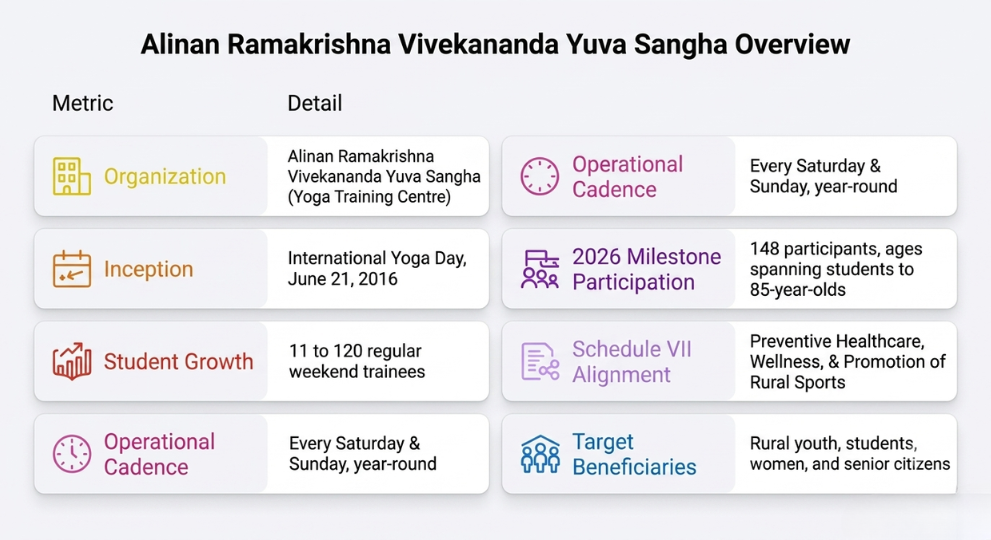
The Yoga Training Centre's decade-long journey reflects the consistency and community participation that many corporate CSR programmes seek when identifying grassroots initiatives. Since its inception on International Yoga Day in 2016, the centre has grown from 11 students to 120 regular weekend trainees. On International Yoga Day 2026, it brought together 148 participants, including students, women, senior citizens, teachers, guardians, and community members.
The initiative also aligns with the objectives of Schedule VII of the Companies Act through its focus on preventive healthcare, community wellness, and the promotion of rural sports. This makes it relevant for corporate CSR programmes that support long-term community health and sports-based development.
Frequently Asked Questions
How does the Alinan Ramakrishna Vivekananda Yuva Sangha Yoga Centre impact local health?
- By running structured yoga training every Saturday and Sunday for a decade, the centre has built a preventive healthcare habit across three generations — from students to 85-year-old participants — reducing lifestyle-disease risk in a rural population that typically has limited access to organized wellness infrastructure.How can corporate donors support Verified Community Wellness Projects in West Bengal?
-Corporate CSR heads can partner with BCF to directly fund verified, high-impact initiatives like the Yoga Training Centre — gaining transparent governance documentation, Schedule VII compliance mapping, and measurable participation data in return.Why is weekend yoga training eligible for corporate CSR under Schedule VII?
- Because it falls under Preventive Healthcare, Wellness, and Promotion of Rural Sports — categories explicitly recognized under Schedule VII of the Companies Act, making structured, verifiable wellness programs like this one a compliant CSR investment.
Conclusion: A Decade in the Making, Still Just Getting Started
What began with 11 students and one instructor on a single June morning in 2016 is now a decade-strong institution — 120 weekly trainees, 148 participants at its most recent milestone, and an 85-year-old man in a 'dhuti' proving that discipline has no expiry date.
This is what a Verified Community Wellness Project in West Bengal looks like when it's given a decade to grow: not a single event, but a standing commitment that a community renewed every weekend, without needing anyone to ask them to.
BCF's role now is simple — make sure the corporate partners who want to fund stories like this one can find it.
About BCF:
The BCF Portal (bengalchamberfoundation.org), developed by The Bengal Chamber of Commerce and Industry (BCC&I)—one of India's oldest chambers—serves as a trusted intermediary connecting verified West Bengal NGOs with corporate CSR mandates. We publish NGO success stories because funding gaps are often information gaps, sitting at the intersection of corporate philanthropy and grassroots impact every day.