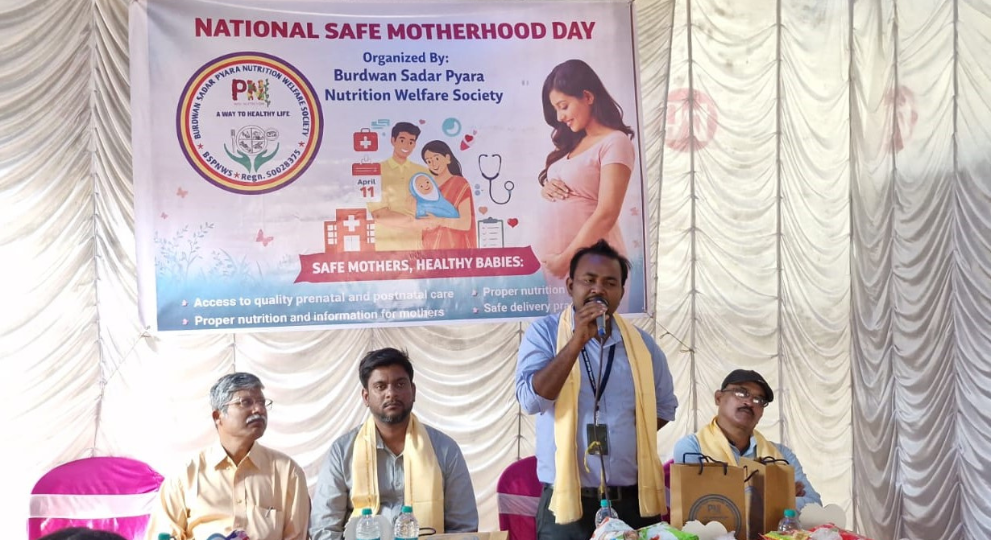
Every year on April 11, India observes National Safe Motherhood Day — a nationally recognised commitment to ensure that every woman, regardless of her economic background, geographic location, or social standing, has access to safe, dignified healthcare throughout her pregnancy, childbirth, and the weeks that follow.
But for most, this day passes as a date on a calendar. A social media post. A government circular. A seminar in a conference room.
For one small NGO in the heart of Burdwan, West Bengal, it became something far more powerful — a day of action.
Meet the Organisation That Took This Challenge to Heart
Burdwan Sadar Pyara Nutrition Welfare Society (BSPNWS) is a Bengal Chamber Foundation (BCF)-registered NGO, based at 3 No. Shankari Pukur, Sripally, East Burdwan (Pin-713103), operating under the Society Registration Act of 1961.
Founded in 2022, BSPNWS is just over three years old—and yet the strides it has taken would make even well-established organisations pause and take note.
To commemorate National Safe Motherhood Day 2026, BSPNWS chose a theme that is both a declaration and a challenge:
"Equity in Maternal Healthcare: Leaving No Mother Behind."
This was not a theme chosen lightly. It was chosen with purpose—because BSPNWS knows, from ground-level experience, what inequity in maternal healthcare actually looks like. It looks like a pregnant woman in Kondrapara, Burdwan, is navigating her pregnancy without access to the expert guidance that women in metropolitan hospitals take for granted. It looks like a gap that no policy alone can fill.
The word 'equity' is deliberate. It does not ask for equal resources distributed uniformly. It asks for the right support, reaching the right mother, at the right time. This theme set the stage. And BSPNWS chose not just to observe it but to live it.
Built on the foundational belief that you cannot have healthy mothers without a healthy environment, and you cannot have a healthy society without empowered women, BSPNWS works boldly at the crossroads of nutrition, women's welfare, and environmental health. They operate not from a place of charity, but from a place of deep conviction.
The Problems They Saw — And The Solutions They Built That Most Others Walked Past
While policy papers debated maternal mortality statistics, BSPNWS was on the ground — and what they saw was urgent, layered, and deeply human. They did not wait for the policies to change. They acted.
Problem 1 — Toxic Ground, Silent Danger
In the school gardens adjacent to the kitchens of some Burdwan institutions like Kanchannagar D.N. Das High School, Lakurdi Vidyamandir, Sadhumati Girls' School, and Vidyarthi Bhavan Girls High School, a quiet environmental crisis had been building.
Continuous rains and the absence of the schools' green volunteer support had allowed wild weeds and the invasive, toxic Parthenium hysterophorus to overtake the gardens entirely.
Parthenium is no ordinary weed. It depletes soil nutrients, triggers severe allergies, and contributes to localised environmental degradation — posing a direct, daily risk to the surrounding community, including the pregnant women who live and move through these spaces.
Solution they made – Cleaning the Earth to Protect Its Mothers
BSPNWS volunteers mobilised across all four schools to manually uproot and clear the toxic Parthenium and invasive weeds from the garden areas near school kitchens. With student volunteers unavailable due to ongoing exams and weeks of rain compounding the damage, the Society stepped in directly — without waiting to be asked.
They restored soil fertility. They reduced chemical and allergenic risk. They literally cleaned the earth — because BSPNWS understands something most overlook: a healthy environment is where every healthy pregnancy begins.
Problem 2 — Information Poverty in the Most Critical Months of a Woman's Life
Apparently, while working on clearing the weeds, they came across something very dangerous - The Information Poverty of these pregnant women. In the homes of Ranibagan and Kondrapara, pregnant women had no access to structured, reliable information about safe pregnancy practices, warning signs during childbirth, or postpartum care. The knowledge gap was not a minor inconvenience — it was a matter of life and death, at a time when the right information at the right moment can be the difference between a safe delivery and a tragedy.
Solution they made — Bringing Expert Knowledge Into the Community, Free of Charge
BSPNWS organised a structured awareness programme for pregnant women and women aged 18–44 from Ranibagan and Kondrapara. The session was addressed by Dr. Subrata Bapari, a specialist from IQ City Hospital, Durgapur, and health expert Bipul Dutta — covering danger signs during pregnancy, safe delivery practices, and postnatal recovery.
Expert guidance that urban women access routinely was brought directly into the hands of the women who need it most — and can least afford to seek it. Free of charge. No barriers. No distance.
Problem 3 — Eleven Mothers, Clinically Underweight, Carrying Lives at Risk
Perhaps the most alarming finding on the ground was this: pregnant women are clinically underweight. The risks were not abstract — low birth weight babies, maternal anaemia, and life-threatening complications during delivery were real and imminent possibilities for each of these women.
Solution they made — Taking Charge, for 18 Months, Without Looking Away
In the most concrete — and perhaps the most remarkable — act of the day, BSPNWS formally adopted all 11 clinically underweight pregnant
mothers into a structured, 18-month welfare programme.
Beginning immediately with the first month of high-protein, balanced nutritional support — including essential food packets — this programme
ensures that not one of these mothers is left to navigate pregnancy-related malnutrition alone.
This is not a one-time donation. This is not a photo opportunity. This is care made measurable and compassion made accountable — sustained over a year and a half, for real women carrying real lives into the world.
Three Steps. One Powerful Philosophy
Three problems. Three solutions. One NGO that refused to look away. This grassroots NGO truly turned this symbolic observance of National Safe Motherhood Day 2026 into a day of tangible, measurable impact.
The Society's Secretary, Pralay Majumdar, captured the philosophy driving it all:
"If the soil is not pure, all living beings on earth — including humans — are endangered. Just as Mother Earth must be kept free from pollution, the human mother's pregnancy must be protected, and the birth of a healthy, strong, right-weight baby must be ensured."
That belief — that environmental health and maternal health are inseparable — shaped every action taken on this day.
Why Is BCF Proud to Share This Story?
At the Bengal Chamber Foundation (BCF), we have had the privilege of witnessing the work of many NGOs across West Bengal. We have seen organisations donate books, distribute clothes, organise food drives — all of it valuable, all of it needed.
But what BSPNWS did on National Safe Motherhood Day 2026 is different. It is out of the box. It is eye-opening. And frankly, it is rare.
For an organisation that is barely three years old, formally adopting 11 underweight pregnant women into an 18-month structured welfare programme is not a small act — it is an extraordinary one. It requires planning, resources, accountability, and above all, an unshakeable commitment to follow through.
Their grassroots-level impact is not just inspiring — it is a replicable model for how community-led maternal care can actually work when conviction meets action.
BCF is proud to bring this story the visibility it deserves.
About Bengal Chamber Foundation (BCF)
The Bengal Chamber Foundation (BCF) is the CSR and social impact arm of The Bengal Chamber of Commerce and Industry (BCC&I) — one of India's oldest and most respected chambers of commerce. BCF serves as a credibility bridge between high-impact grassroots NGOs and the institutional, corporate, and policy ecosystem — providing registered NGOs with visibility, validation, and a platform to scale their work.
Operating across West Bengal, with a focus on underserved communities where institutional support has historically been limited. BCF actively identifies, documents, and amplifies grassroots stories year-round—ensuring that meaningful community work does not remain invisible, regardless of the season or news cycle.
Sustainable development in health, nutrition, and women's welfare is not the result of isolated efforts. It is the outcome of consistent, community-led action backed by institutional support. BCF exists to create that bridge – so that models like BSPNWS gain the reach needed to expand beyond their immediate geography and offer replicable frameworks across the state and beyond.
As a benefit of being a BCF-affiliated NGO, an organisation like BSPNWS gains access to visibility platforms, corporate CSR partnerships, credibility endorsements, and a network of like-minded institutions — multiplying the impact of every rupee spent and every life touched.
Two Mothers. One Legacy. One Future.
The children born today will carry the weight of the choices we make right now.
Whether it is Mother Earth, healing slowly from years of environmental neglect, or an underweight mother in Kondrapara, carrying her baby carefully toward a full and safe term, neither can be left to struggle alone.
NGOs like BSPNWS understand this deeply. They work not for recognition, not for scale metrics, and not for annual reports – but because they refuse to accept a world where any mother is left behind. Be it the mother nurturing life in her womb or the earth nurturing life in its soil – both are the future. Both are our legacy.
And organisations like BSPNWS are quietly, steadfastly carrying that legacy forward — one mother, one garden, one healthy birth at a time.
Call for Your Turn
If you are an individual who believes in this work, an institution looking to make a meaningful CSR contribution, or an NGO working in a similar space, connect with Bengal Chamber Foundation (www.bengalchamberfoundation.org). Let us build a network where more mothers receive the care, nutrition, and dignity they deserve.
Together, we can ensure that "Leaving No Mother Behind" is not just the theme of a day but the lived reality of every mother, every day.