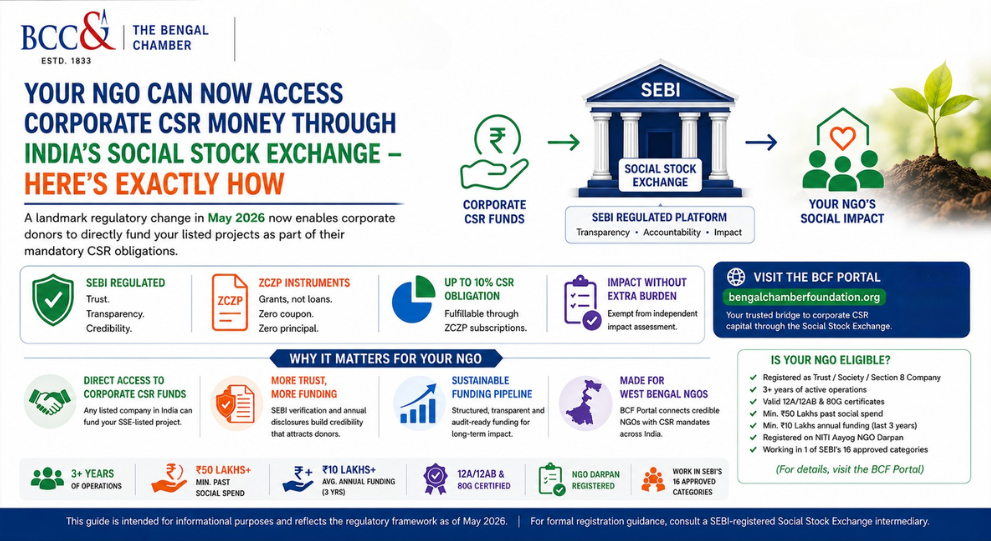
If your NGO has been doing meaningful work for at least three years but struggles to find reliable, transparent funding — the Social Stock Exchange may be the most significant opportunity you haven't heard enough about yet. A landmark regulatory change in May 2026 now makes it possible for corporate donors to directly fund your listed projects as part of their mandatory CSR obligations. This is a guide for NGOs and social enterprises in West Bengal and across India on registering with SEBI's Social Stock Exchange (SSE) and unlocking the new 2026 CSR funding route. This guide walks you through everything, step by step.
In this guide
- What is the Social Stock Exchange — in plain language?
- Why does this matter specifically for NGOs in West Bengal
- The 2026 MCA Amendment: What changed and what it means for you
- Is your NGO eligible? The complete checklist
- How to register: A step-by-step walkthrough
- How the Bengal Chamber Foundation can help you get there
- Frequently asked questions
What is the Social Stock Exchange — in layman’s language?
India has a stock market where companies raise money from the public. The Social Stock Exchange works the same way — except that instead of companies, NGOs raise money for social causes. Think of the Social Stock Exchange (SSE) as a verified marketplace where credible NGOs can raise funds.
It operates as a dedicated segment within India's two major exchanges — the NSE (National Stock Exchange) and the BSE (Bombay Stock Exchange) — and is regulated by SEBI (Securities and Exchange Board of India). That SEBI oversight is the key difference between the SSE and every other funding channel your NGO has used before.
Why does SEBI regulation matter to your NGO?
Credibility isn't something you have to prove in a pitch meeting. The system proves it for you.
Before an NGO can raise a single rupee on the SSE, SEBI verifies who you are, checks your financials, and requires you to report your impact every year. Corporate donors can see all of this. That's why they trust and fund your NGO.
When a corporate donor contributes to your project through the SSE, they will not choose you among the thousands of NGOs working in the same cause area as you are working on, based only on your presentation. This is where the importance of SEBI comes in. SEBI's framework mandates verified registration, annual disclosures, and impact reporting. This is precisely what makes corporate CSR departments willing to fund SSE-listed NGOs at scale.
Both the NSE and BSE host their own SSE segments. For practical purposes, both follow the identical SEBI rules and offer the same fundraising mechanisms — you may register on either platform based on your preference or your advisor's guidance.
Why does this matter specifically for NGOs in West Bengal?
West Bengal is home to one of India's oldest and most active civil society ecosystems—from century-old trusts in Kolkata to grassroots community organisations working in the Sundarbans, North Bengal's tea belt, and across rural districts. Yet funding has historically been a bottleneck for many of these organisations: donor relationships are personal, CSR spending is often informal, and accountability structures vary widely.
The SSE changes this fundamentally. For NGOs in Kolkata and across West Bengal, it opens a structured, institutional channel to access corporate CSR funding from across India — not just from locally headquartered companies. Any listed company with CSR obligations anywhere in India can now fund your SSE-listed project.
Platforms like the Bengal Chamber Foundation (BCF) Portal, developed by The Bengal Chamber of Commerce and Industry (BCC&I), are already bridging this gap. The BCF portal vets NGO partners and aligns them with corporate CSR mandates — making it a natural first stop for any West Bengal-based NGO preparing to engage with the SSE ecosystem.
The 2026 MCA Amendment: What changed and what it means for you?
On May 27, 2026, the Ministry of Corporate Affairs (MCA) officially notified The Companies (Corporate Social Responsibility Policy) Amendment Rules, 2026. This is the most significant policy update for the SSE since its launch, and it directly affects how your NGO can receive CSR funding.
At the heart of this amendment is a mechanism called the Zero Coupon Zero Principal (ZCZP) Instrument. The name sounds complex — but the concept is simple:
ZCZP explained simply
A ZCZP instrument works like a grant, not a loan. When a company subscribes to a ZCZP issued by your NGO, they are funding a specific social project. They do not expect repayment of the principal and do not earn any interest. The "investment" is entirely philanthropic — but it is now structured, documented, and exchange-listed.
For your NGO, this means you can issue a ZCZP for a specific project (say, a school nutrition programme or a flood relief initiative), and companies can subscribe to it as part of their mandatory CSR spend.
Four things the 2026 amendment changes for NGOs seeking CSR funding
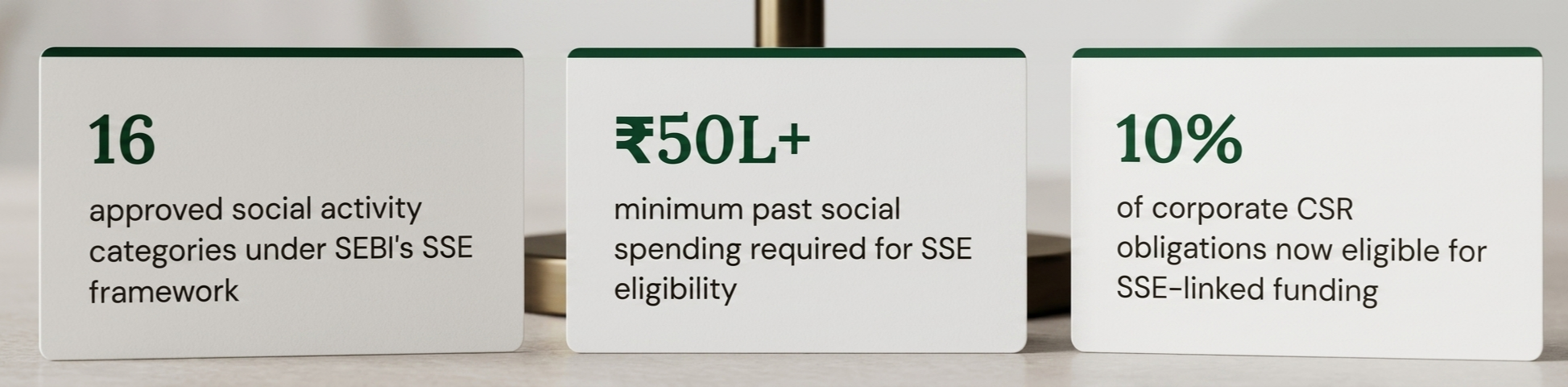
- Companies can now fulfil up to 10% of their annual CSR obligation by subscribing to ZCZP instruments issued by SEBI-listed NGOs — creating a direct, reliable funding channel
- CSR expenditure made through ZCZP subscriptions is fully exempt from independent Impact Assessment requirements, which reduces the compliance burden on the corporate donor and makes your project easier to fund
- Schedule VII of the Companies Act has been formally amended to recognise ZCZP subscriptions as an eligible CSR activity — meaning this is now law, not just a guideline
- The amendment makes the SSE a preferred implementation route for corporates seeking transparent, audit-ready CSR deployment — incentivising companies to seek out listed NGOs rather than unverified implementing partners.
What this means for your NGO’s funding pipeline:
The 2026 amendment significantly lowers the friction for corporate donors to fund your work. The traditional hurdles – donor relationship-building, impact assessment negotiations, and long approval cycles – are substantially reduced when you operate within the SSE framework.
Is your NGO eligible? The complete checklist
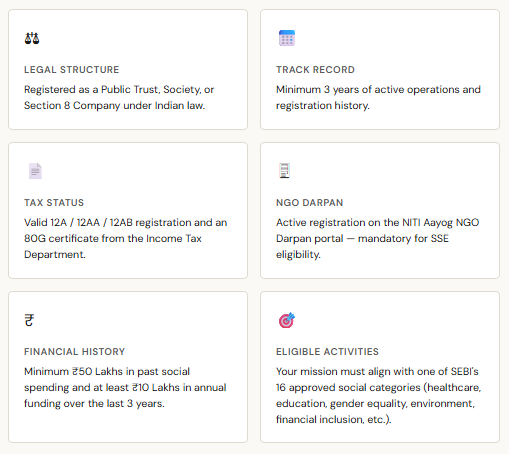
Before you begin the registration process, your organisation must meet SEBI's baseline criteria. Here is what you need to have in place:
If your NGO is newer or smaller than these thresholds, the BCF portal can help you identify readiness gaps and work toward SSE eligibility over time. It is better to prepare now than to miss the window when CSR capital is actively flowing toward listed organisations.
How to register: A step-by-step walkthrough
- Confirm your eligibility and gather your documents
Before approaching the exchange, assemble the following. Missing even one document will delay your application.
- NGO Registration Certificate + Deed / Memorandum of Association / Bylaws
- PAN Card of the organisation
- Valid 12A / 12AB and 80G certificates (must not be expired)
- Audited financial statements and Annual Reports for the last 3 consecutive years
- A formal resolution passed by your governing board authorising SSE registration
- Verify your NGO Darpan registration is active
Log in to the NITI Aayog NGO Darpan portal and confirm your profile is current and complete and reflects your active operations. This registration is a hard prerequisite — the SSE application will not proceed without it.
- Submit your application on the BSE listing portal
- Navigate to the BSE's online listing portal and select the Social Stock Exchange tab.
- Fill out the comprehensive organisational questionnaires, upload your documents, and submit for review.
- The exchange may request clarifications – respond promptly to avoid delays.
You may alternatively list on the NSE's SSE segment. Both operate under the same SEBI rules; choose the platform where your advisors or intermediaries have existing relationships.
- Receive NPO registration status and list your projects
Once the exchange approves your application, your NGO is officially registered as an NPO on the SSE. You can then list individual social projects and begin issuing ZCZP instruments — opening your work to corporate CSR subscribers from across India.
- Maintain ongoing disclosure and impact reporting
Registration is not a one-time event. SEBI's framework requires annual disclosures and impact reporting for listed projects. Build this reporting discipline into your operations from day one – it is what sustains your credibility with corporate donors and keeps your listing in good standing.
How the Bengal Chamber Foundation helping NGOs get there?
The Bengal Chamber Foundation (BCF), the CSR and social impact arm of the Bengal Chamber of Commerce and Industry (BCC&I), has built a dedicated platform to help West Bengal's NGO ecosystem navigate exactly this transition.
About the Author:
The BCF Portal (bengalchamberfoundation.org) serves as a trusted intermediary — it vets partner NGOs, aligns them with corporate CSR mandates, and creates accountable, impact-measurable pathways between donors and implementing organisations. As the SSE ecosystem matures, the BCF portal is positioned as a natural bridge for West Bengal-based NGOs to connect with CSR capital from BCC&I's corporate membership and beyond. The Bengal Chamber Foundation works with NGOs across West Bengal to build the required credibility, documentation, and institutional connections needed to access structured CSR funding.
BCF publishes NGO Stories and informational guides benefiting the NGO interests because we believe funding gaps are often information gaps. We sit at the intersection of corporate CSR and the NGO ecosystem every day. We see firsthand how NGOs doing marvellous groundwork miss funding simply because they don't know the system. These blogs intend to change that.
We write for NGOs because informed organisations make better partners, and better partnerships create real impact. Visit the BCF Portal — developed by The Bengal Chamber of Commerce and Industry — one of India's oldest chambers of commerce.
This guide is intended for informational purposes and reflects the regulatory framework as of May 2026. For formal registration guidance, consult a SEBI-registered social stock exchange intermediary.
Frequently asked questions
- What is Social Stock Exchange (SSE) in India?
The Social Stock Exchange (SSE) is a regulated marketplace for social impact fundraising, operating as dedicated segments within the NSE and BSE under SEBI oversight. It allows verified Not-for-Profit Organisations (NPOs) and For-Profit Social Enterprises (FPEs) to raise funds from the public, institutional donors, and corporate CSR budgets in a transparent, structured manner.
- What is the ZCZP instrument, and how does it benefit my NGO?
A Zero Coupon Zero Principal (ZCZP) instrument is a financial instrument issued by an SSE-listed NGO for a specific social project. It functions like a grant — the corporate subscriber funds the project without expecting a return of principal or any interest. Following the 2026 MCA Amendment, companies can now use ZCZP subscriptions to fulfil up to 10% of their mandatory annual CSR obligation, and these contributions are exempt from independent Impact Assessment requirements.
- Which NGO's are eligible for registering on the Social Stock Exchange in India?
To be eligible for SSE registration, an NGO must be registered as a Public Trust, Society, or Section 8 Company with at least 3 years of active operations. It must hold valid 12A/12AB and 80G tax exemptions, be registered on the NITI Aayog NGO Darpan portal, demonstrate minimum past social spending of ₹50 Lakhs, maintain annual funding of at least ₹10 Lakhs over the last 3 years, and work in one of SEBI's 16 approved social activity categories.
- What is Bengal Chamber Foundation (BCF) and how can it help my NGO?
The Bengal Chamber Foundation (BCF) is the CSR and social impact initiative of The Bengal Chamber of Commerce and Industry (BCC&I), one of India's oldest chambers of commerce. The BCF Portal (bengalchamberfoundation.org) vets and connects credible NGOs in West Bengal with corporate CSR mandates, ensuring accountability and impact measurement. For NGOs preparing to engage with the SSE, the BCF portal serves as a trusted bridge — helping organisations build the documentation, credibility, and corporate relationships needed for SSE-linked funding.