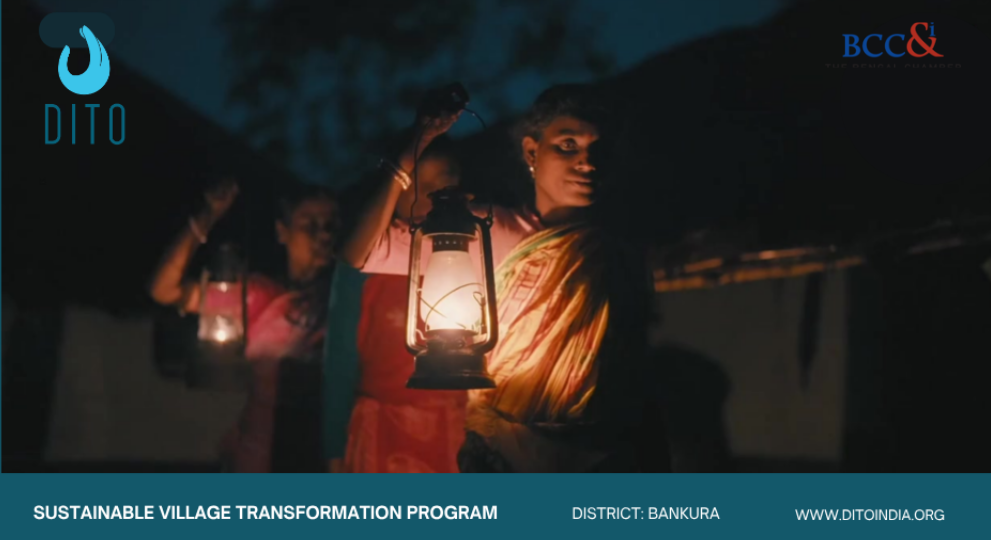
At Bengal Chamber Foundation, we believe that impact which happens far from a camera, far from a press release, and far from the nearest paved road — is often the impact that matters most. Our NGO portal exists to find these stories, verify and collaborate with them, and bring them to the attention of donors, CSR partners, and policymakers who have the power to scale what works.
This is one of those stories. A Village of Nearly 1,000 People. Ten Years of Unanswered Letters. One Solar Intervention That Changed Everything.
We are proud to feature DITO Social Welfare Association's work on the BCF platform — not because the story has a tidy ending, but because it is honest, replicable, and worth knowing about.
Deep in the laterite landscape of Bankura district — about 14 kilometres from the nearest paved road — lies Banjora Santhalpara, a settlement of more than 350 Santhal tribal families. For nearly a decade, its residents did what every responsible citizen should: they wrote letters, filed petitions, attended gram sabha meetings, and raised their needs with the Block Development Officer.
They asked for two things. Light on the paths they walked after dark. And safe drinking water.
Neither arrived.
What arrived instead, in the winter of 2024, was a small NGO in Bengal team from DITO Social Welfare Association — a Section 8 non-profit based in Kolkata — with a question rather than an agenda: “What would make the most difference?”
The answer from nearly every household was identical. Light. And water.
The Problem: What Darkness Really Means in Rural India
For those living in urban India, the absence of streetlights may sound like a minor inconvenience. In Santhalpara, it was a nightly curfew imposed by geography and neglect on close to 1,000 people.
- Women collecting water at dawn or dusk navigated completely unlit paths
- Children returning from evening tuition relied on mobile phone torches held by older siblings
- Snakebite — a genuine seasonal hazard in Bankura's laterite belt — was not an abstract fear but a lived reality on dark paths
- Elderly residents with failing eyesight had simply stopped venturing out after 5 PM in winter
The water crisis was equally stark. At some point in the past, the local government had installed a conventional submersible pump in the village — a formal acknowledgement that the community needed a reliable water source. That pump had long since stopped working. Without grid electricity and without a maintenance plan, it sat idle: a rusting symbol of a promise half-kept.
Residents fell back on shallow hand pumps, drawing iron-contaminated groundwater. Rust-coloured. Metallic. Unsafe. They knew it. They drank it anyway, because the alternative — walking two kilometres twice a day to the nearest jal dhara point — was simply not feasible for women already carrying the weight of subsistence farming, childcare, and firewood collection.
"We wrote so many times. After a while you stop expecting anyone to come. We just learned to manage." — A resident of Santhalpara.
The Intervention: Solar Technology as a Development Tool
A grassroot NGO in Bengal - DITO Social Welfare Association's approach was grounded in a simple but powerful principle: listen first, build second.
Rather than arriving with a pre-approved scheme, the DITO team conducted a community survey, prepared technical drawings, held a community meeting, and worked alongside village residents for several weeks during construction.
Solar LED Street Lighting
DITO installed solar-powered LED street lights at key points along Santhalpara's internal pathways:
- The route to the hand pump
- The school approach road
- The main thoroughfare connecting the hamlet's two residential clusters
- The path to the nearest market road
Each unit was a self-contained, off-grid system — solar panel, battery, and low-maintenance LED fixture. No grid connection. No recurring electricity bill. No dependency on a supply that had never reliably reached the village.
Solar-Enabled Submersible Water Pump
For the water problem, DITO took a technically elegant approach. Rather than petitioning for a new borewell or waiting for a grid connection that might never arrive, the team identified what actually existed and what had failed: the government's borewell infrastructure was structurally sound. Only its power source — a conventional motor dependent on grid electricity — had failed.
DITO replaced the failed conventional motor with a solar-powered submersible pump, powered by a photovoltaic panel and entirely independent of the grid. The existing borewell now drew from the deeper, cleaner aquifer it was designed to reach, feeding a central distribution point accessible to all families in the settlement.
The total investment was modest. The impact was not.
What Changed: The Results on the Ground
Immediate Visible Change
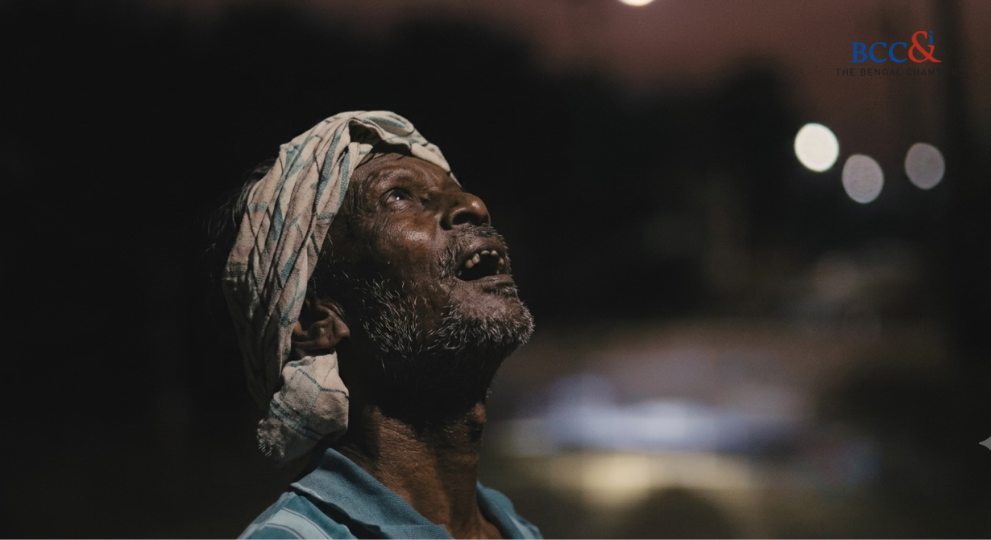
The most literal transformation was light. Pathways that had gone dark at sunset were now lit. Children walked to and from evening tuition. Women collected water after dark without fear. Elderly residents began going out in the evenings again.
The fear of snakebite on unlit paths — so commonplace it had stopped being spoken about — receded.
Women's Safety
In a hamlet with no police presence and no reliable mobile network after dark, lighting the pathways fundamentally changed the terms on which women and girls moved through their own village.
Mothers reported no longer accompanying their teenage daughters to the hand pump at night. The lit path was enough. That single sentence — quiet, understated — contains an entire architecture of worry being lifted.
Improved Public Health
Within weeks of the solar-enabled pump becoming operational, residents reported a visible change in their water: the rust tinge was gone; the metallic taste was gone.
Over the following months, community health workers from DITO's Last Mile Health Care programme observed a marked reduction in gastrointestinal illness complaints among children under five — the population most vulnerable to waterborne disease. Formal clinical data is still accumulating, but the early signal is unambiguous.
Restoration of Dignity
Perhaps the most important change is also the hardest to quantify. For nearly a decade, the residents of Santhalpara had asked their government for help and been ignored. The solar infrastructure did not solve every problem in the hamlet. But it solved the two problems that the residents themselves — not outsiders — had identified as most urgent.
It was built by listening to them first.
"Now when the children study in the evening and the women walk to collect water, there is light. It is a small thing for you to read about. It was not a small thing for us to receive." — Village elder, Banjora Santhalpara.
What the Lights Don't Fix — and Why That Honesty Matters
It would be dishonest to stop the story here, at the moment the lights switched on.
Santhalpara still has no paved road. The nearest primary health centre is 14 kilometres away. Mobile connectivity is intermittent. The government school is understaffed. Young men still migrate seasonally to brick kilns and construction sites in Howrah and Kolkata because sustainable local livelihoods don't yet exist.
Solar street lights and a water pump don't fix these things.
What they do is remove two of the most immediate daily burdens — darkness and unsafe water — and in doing so, free up the time, energy, and safety margin that had not previously existed. They are not the end of the work. They are, at best, the conditions under which the harder work becomes possible.
DITO's team is clear-eyed about this. The solar infrastructure in Santhalpara is one component of the Sustainable Village Transformation Programme being implemented across rural Bankura in partnership with Rahee Cares, the CSR arm of Rahee Infratech Limited. The programme's other components work in parallel:
- Last Mile Health Care — preventive and primary health access
- Project Kishalaya — school upgradation and learning infrastructure
- Project Swanirbhar — livelihood training and economic self-reliance
The theory is straightforward, even if the execution is not: a village needs all of it at once. Light without health access is incomplete. Health access without education is fragile. Education without livelihood is a one-way ticket to migration. Integration is the point.
The Question That Lingers
There is an uncomfortable question underneath this story.
Why did it take a non-profit from Kolkata to install solar street lights and restart a dead water pump in a settlement of nearly 1,000 people?
Santhalpara is not hidden. It is not inaccessible. It is not in a conflict zone. It is a known, registered Scheduled Tribe settlement in a district that receives substantial government funding for tribal welfare. Its residents did everything right — they wrote, they petitioned, they attended meetings — for close to a decade.
The government's own submersible pump, drilled into the village and then abandoned without maintenance, is perhaps the most vivid symbol of that systemic failure.
DITO's intervention was necessary.
The work of an NGO, at its best, is to demonstrate what is possible and to hold space until the state arrives. It is not a substitute for the state. The residents of Santhalpara understand this clearly. They are grateful for the lights. They are not under the illusion that the larger questions have been answered.
What has perhaps changed is the platform from which they can ask those questions. It is easier to advocate for a road, a health centre, and a staffed school when you are no longer simultaneously fighting for the two most basic things: light and water.
In Banjora Santhalpara, for the first time in a decade, the preconditions for that advocacy are in place.
About DITO Social Welfare Association
DITO Social Welfare Association is a Section 8 non-profit registered under the Companies Act (80G | 12AA | CSR-1 | NGO Darpan ID: WB/2018/0202059), operating since 2016 across five districts of West Bengal.
The organisation works at the intersection of health, education, and livelihood through its flagship programmes:
- Last Mile Health Care — reaching the unreached with preventive and primary health services
- Project Ujaan — community empowerment and awareness
- DITO Scholarship — enabling higher education for underserved students
- STEM for HER — science education access for girls
- Project Kishalaya — school infrastructure and learning quality
- Project Swanirbhar — livelihood and vocational training
The Sustainable Village Transformation Programme in Banjora Santhalpara is implemented in partnership with Rahee Cares, the CSR initiative of Rahee Infratech Ltd.
About Bengal Chamber Foundation (BCF)
Bengal Chamber Foundation (BCF) is the social and philanthropic arm of the Bengal Chamber of Commerce and Industry (BCC&I) — one of India's oldest and most respected chambers of commerce, established in 1853. BCF serves as a bridge between the corporate sector, civil society, and grassroots development organisations across West Bengal and beyond.
Through its NGO Portal and Impact Platform, BCF curates and amplifies the work of credible non-profits, enabling greater visibility for field-level impact stories, facilitating CSR partnerships, and fostering a culture of accountable, evidence-based philanthropy in eastern India.
BCF's areas of focus span education, healthcare, livelihoods, environment, and community resilience — supporting organisations that work at the last mile, in geographies and communities that mainstream institutional attention often bypasses.
By featuring impact stories like DITO Social Welfare Association's Sustainable Village Transformation Programme in Bankura, BCF reinforces its commitment to shining a light on work that is quiet, rigorous, and genuinely transformative — work that deserves far wider recognition and support.
🌐 Visit the BCF NGO Portal to explore more impact stories and partnership opportunities.
Frequently Asked Questions
1. What did DITO Social Welfare Association do in Banjora Santhalpara?
DITO installed solar-powered LED street lights along key pathways and replaced a non-functioning government-installed water pump motor with a solar-powered submersible pump, providing clean water and safe lighting to nearly 1,000 Santhal tribal residents in Bankura, West Bengal.
2. What is the Sustainable Village Transformation Programme?
It is DITO Social Welfare Association's integrated rural development programme implemented in Bankura in partnership with Rahee Cares (CSR arm of Rahee Infratech Ltd.), combining solar infrastructure, health access, education upgradation, and livelihood training.
3. Is DITO Social Welfare Association CSR-eligible?
Yes. DITO Social Welfare Association holds 80G, 12AA, and CSR-1 registrations and is listed on NGO Darpan (ID: WB/2018/0202059), making it eligible for CSR contributions under the Companies Act.