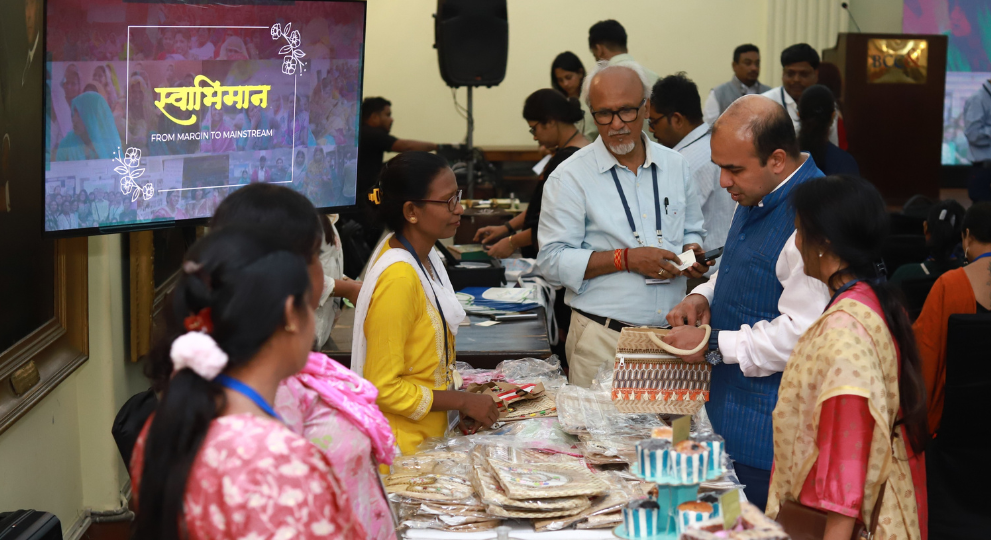
From a Survey of 20,000 Women to 4,500 Entrepreneurs.
Not every programme that comes to BCF's attention earns a place on this portal. What we look for is specific: credible implementation, institutional partnerships that go beyond name-lending, a design that treats beneficiaries as agents rather than recipients, and numbers that have been earned rather than estimated.
The Swabhimaan programme by the Impact360 Foundation clears every bar. It is funded by Citibank, technically anchored by IIT Kanpur's Startup Incubation and Innovation Centre. It began with a survey of more than 20,000 women living in city slums. Its outcomes are measured in 4,500 seed-funded businesses. Between those two points lies a story of rigorous design, genuine partnership, and the kind of stubborn belief in human potential that Bengal Chamber Foundation exists to amplify. We are proud to feature this work on our platform, and we hope it finds the donors, CSR partners, and policymakers it deserves.
This Is What Urban Poverty Reduction Looks Like.
In the densely populated urban slums across Kolkata's south, central, and eastern KMC wards, tens of thousands of women wake up every morning to the same arithmetic of constraint: limited income, limited access to capital, and limited belief — instilled by years of exclusion — that any of this can change.
Swabhimaan was built to change that arithmetic. An urban poverty reduction initiative focused on one deceptively simple idea: that women already have skills, drive, and market-ready potential. What they lack is structure, capital, and someone to believe in them first.
The programme set out to provide all three.
The Problem: Skill Without Structure, Potential Without a Path
Self Help Group women in Kolkata's urban slums are not passive recipients of poverty. They are active agents – running households, managing finances, and raising children. Many already possess skills: they stitch, bake, style hair, make handicrafts, and run small retail operations from home.
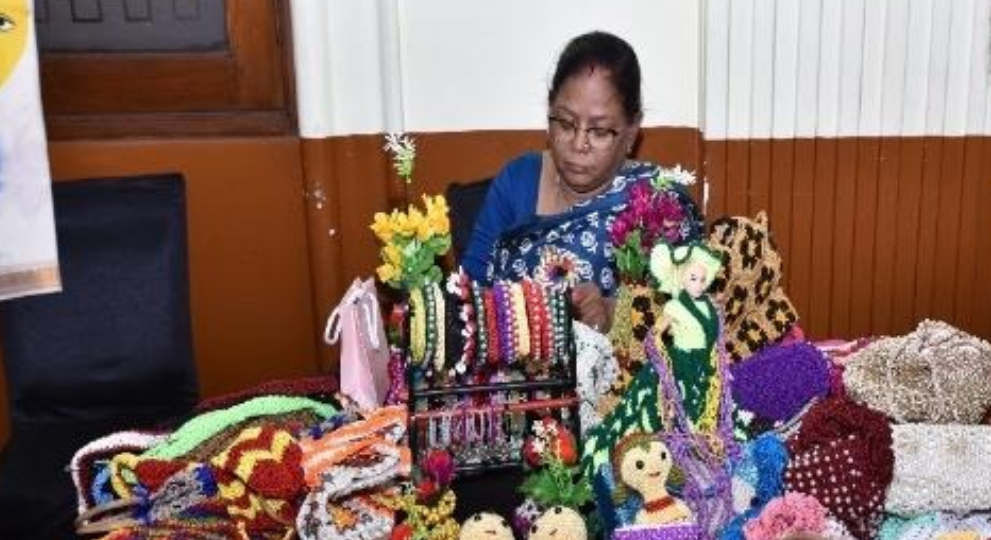
What they lack is the formal architecture that turns a skill into a business: a plan, a registration, a market, a financial cushion for the first hard months, and a mentor who will pick up the phone when the customer doesn't show up.
Swabhimaan was designed to provide exactly this — from first awareness to sustained handholding — for women between 18 and 55 years of age across Kolkata Municipal Corporation wards.
Crucially, the programme also extended its reach to members of the transgender community and persons with disabilities — a deliberate commitment to inclusion that recognises that dignity and self-reliance are not privileges reserved for the easily reached.
The Scale: What 20,000 Surveys and Years of Fieldwork Produced
The numbers behind Swabhimaan are worth mentioning because they tell the story of a programme that did not simply announce itself and wait for participants — it went looking for them.
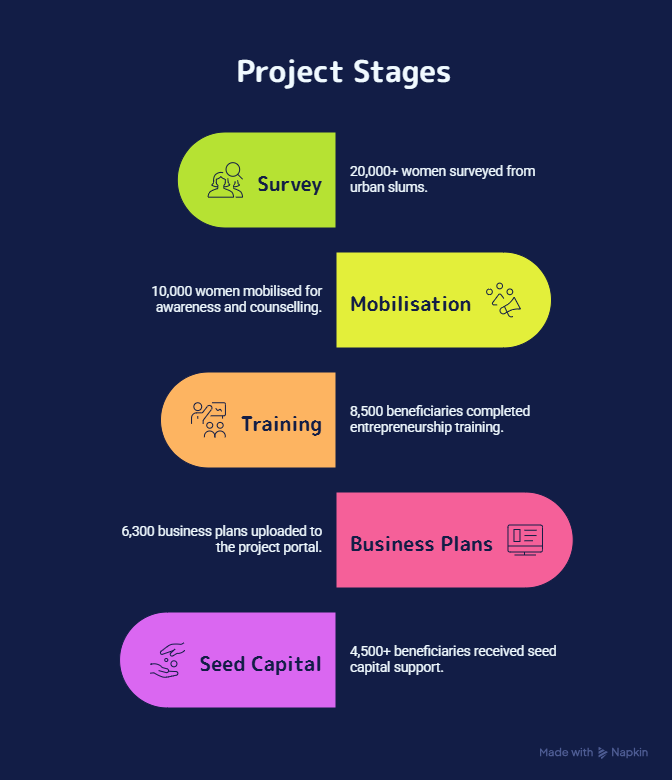
Each step in that funnel represents real fieldwork: awareness campaigns, motivational sessions, stakeholder consultations, and counselling conducted community by community, ward by ward, and household by household.
How Swabhimaan Worked: Five Pillars of the Programme
1. Mobilisation & Community Engagement
Before any training happened, Swabhimaan invested in trust.
- Grassroots mobilisation
- Awareness campaigns
- Community consultations
- Motivational sessions
These activities were conducted across slum communities to identify potential participants, address hesitations, and build the foundational belief that entrepreneurship was not something that happened to other people.
This phase was not a formality. It was the programme's most important infrastructure.
2. Structured Entrepreneurship Training
Selected beneficiaries underwent a comprehensive business development training curriculum covering:
- Business planning and enterprise management
- Financial literacy and budgeting
- Marketing and branding strategies
- Customer relationship management
- Digital awareness and online business promotion
The training was designed to provide both practical exposure and conceptual grounding – equipping women not just to start a business but also to sustain and grow one.
3. Business Plan Development & Digital Portal Upload
Every participant was supported in developing a structured, realistic business plan grounded in local market demand, personal expertise, and feasible financial projections. These plans were then uploaded to a dedicated project portal for evaluation, approval, and ongoing monitoring by the programme's technical partner, IIT Kanpur's Startup Incubation and Innovation Centre.
This process served two purposes: it gave each beneficiary a roadmap for her own enterprise, and it created a transparent, trackable system that ensured accountability across the programme.
4. Seed Capital Support
Selected beneficiaries received seed capital — the financial foundation to move from plan to practice. For women who had never had access to formal credit or startup capital, this was often the single most transformative element of the programme. It was not charity. It was the confidence that comes from someone betting on you with real money.
5. One-to-One Monitoring & Mentorship
Swabhimaan's most distinctive feature was what happened after the training and the capital were delivered to these women. The programme's team conducted regular one-to-one monitoring visits, counselling sessions, and follow-ups — tracking progress, troubleshooting operational challenges, supporting sales growth, and helping entrepreneurs think about the next phase of their business.
This sustained handholding is what separates Swabhimaan from a training programme. It is an entrepreneurship ecosystem.
The Sectors: Where the Businesses Actually Grew
Swabhimaan's upskill training focused on three sectors identified for strong local demand and genuine income potential:
- Tailoring — Advanced training in stitching techniques, garment finishing, measurement, and modern fashion trends, enabling women to establish home-based units and explore boutique partnerships.
- Bakery — Training in preparation, hygiene standards, packaging, costing, and product presentation, producing market-ready entrepreneurs in one of Kolkata's most accessible food enterprise sectors.
Beauty & Wellness — Delivered in partnership with Be Bonnie Salon, covering grooming, skincare, haircare, customer handling, and salon management — creating a pipeline of self-employed professionals in the rapidly growing wellness industry.
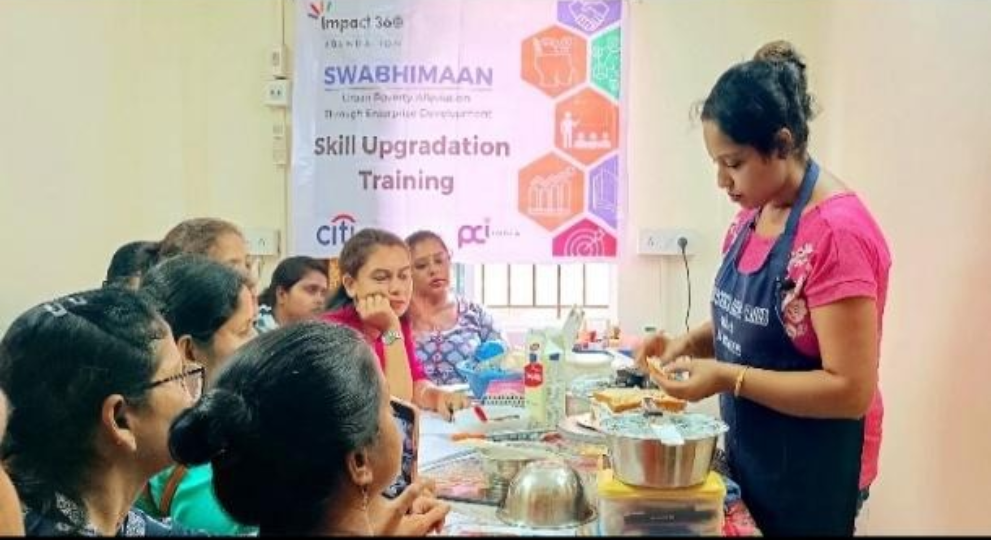
Beyond these three tracks, the programme supported women across food enterprises, handicrafts, retail, and service-based startups – wherever the intersection of personal skill and local market demand created a viable opportunity.
Beyond Training: Connecting Entrepreneurs to the System
One of Swabhimaan's most significant institutional contributions was a workshop organised in collaboration with the District Industries Centre (DIC), Government of West Bengal — bringing together SHG beneficiaries running beauty parlours, tailoring units, and handicraft businesses with government officials who walked them through available schemes, financial assistance programmes, and registration pathways for micro-entrepreneurs.
For women who had historically existed outside formal economic systems, this was a bridge. Not just to knowledge, but to institutional legitimacy.
Participants also took their businesses to exhibitions and trade fairs—showcasing products, building customer networks, and generating income in markets that had not previously been accessible to them.
IIT Kanpur's Startup Incubation and Innovation Centre organised a dedicated success and certificate distribution programme for beneficiaries who had successfully established their businesses—recognising not just entrepreneurial achievement but also the deeper transformation of women who had crossed significant social and economic barriers to achieve this.
The Changes in the Quality of Living That Numbers Don't Capture
By any metric, Swabhimaan produced outcomes that most urban livelihoods programmes would consider exceptional:
- The programme trained 8,500 women, supported 6,300 business plans, and provided seed capital to over 4,500 entrepreneurs.
- Inclusion of transgender community members and persons with disabilities in all programme components
- Active linkage to government schemes through DIC collaboration
- Participation in exhibitions and trade fairs to build market access and visibility
But the numbers don't capture what it means for a woman in a Kolkata slum to walk into a room and pitch her own business plan. Or to receive seed capital and understand, perhaps for the first time, that an institution believes her idea is worth investing in. Or to sit in a workshop with government officials and know that she is not there as a beneficiary — she is there as an entrepreneur.
That shift — from beneficiary to entrepreneur, from excluded to included, from passive to active — is what Swabhimaan was built for.
A representative from the Impact360 Foundation rightly mentioned: "It is our job to empower individuals with skills today to create independent leaders of tomorrow."
What the Programme Doesn't Claim
Swabhimaan does not claim that 4,500 businesses are thriving with no challenges. Urban micro-entrepreneurship is hard. Markets fluctuate. Households impose competing demands on women's time. Access to formal credit beyond seed capital remains a structural barrier.
What the programme claims — and what the evidence supports — is that 4,500 women who did not previously have the tools, capital, or support structure to start a business now have all three. And that for a significant number of them, those tools have translated into real, sustained, income-generating enterprises.
The mentorship and monitoring system that Swabhimaan built is precisely a response to this reality. The programme's design assumes that support cannot end at training or even at capital disbursement. It has to follow the entrepreneur into the field – through the first difficult months, the first customer problem, and the first decision about whether to scale.
That is what distinguishes a livelihood programme from a transformational one.
About The Author:
The Bengal Chamber Foundation (BCF) is the social and philanthropic arm of the Bengal Chamber of Commerce and Industry (BCC&I) — one of India's oldest and most respected chambers of commerce, established in 1853. BCF serves as a bridge between the corporate sector, civil society, and grassroots development organisations across West Bengal and beyond. The editorial team of the BCF is proud to bring such inspiring stories to the forefront.
Through its Portal www.bengalchamberfoundation.org, BCF curates and amplifies the work of credible non-profits, enabling greater visibility for field-level impact stories, facilitating CSR partnerships, and fostering a culture of accountable, evidence-based philanthropy in eastern India.
BCF's areas of focus span education, healthcare, livelihoods, environment, and community resilience – supporting organisations that work at the last mile in geographies and communities that mainstream institutional attention often bypasses.
Impact360 Foundation is one such institution working tirelessly for the betterment of a section of the underprivileged population. The organisation works at the intersection of urban livelihoods, community empowerment, and social inclusion. Through programmes like Swabhimaan, the Foundation focuses on building pathways to economic self-reliance for women and marginalised communities in urban West Bengal.
📹 Watch the Swabhimaan story: https://www.youtube.com/watch?v=CKcy2cljZJU
By featuring impact stories like Impact360 Foundation's Swabhimaan programme, BCF reinforces its commitment to shining a light on work that is rigorous, inclusive, and genuinely transformative — work that deserves far wider recognition and sustained investment.
🌐 Visit the BCF Portal to explore more impact stories and partnership opportunities.
Frequently Asked Questions
- What is the Swabhimaan programme?
Swabhimaan is an Entrepreneurship Development Programme launched by Impact360 Foundation, funded by Citibank, and implemented in partnership with IIT Kanpur's Startup Incubation and Innovation Centre and Project Concern International. It focuses on Self-Help Group women aged 18–55 from urban slum communities across Kolkata's KMC wards, providing entrepreneurship training, business plan support, seed capital, and sustained mentorship.
- Is Impact360 Foundation's Swabhimaan eligible for CSR funding?
Swabhimaan is already funded by Citibank and implemented with IIT Kanpur and Project Concern International. Organisations interested in supporting or scaling the programme can reach Impact360 Foundation through the BCF Portal www.bengalchamberfoundation.org